Wednesday, 23 February 2011

The Paranormal Part I: Noumena, Cognita, or Dreams?

What is reality?

Towards the end of his long life my father’s sight started to deteriorate. During this degeneration he suffered from Charles Bonnet Syndrome, a hallucinatory condition common to the early stages of blindness. In my father’s case the hallucinations were largely of buildings that weren’t there. I was reminded of my father’s casual interest in architecture and the large number of postcards he had collected of the cities he had visited during wartime. In fact in one of his visions he saw the buildings surrounding his house in a state of destruction. Occasionally he also hallucinated people in and around the house and this rather spooked my mother for whom it was no doubt too reminiscent of a haunting for comfort.

As far as I am aware no one has a good theory on CBS; the best I’ve heard is that deprived of the bright and complex patterns of sensory input the visual cortex becomes sensitive to random perturbations and goes into a kind dream state. A particularly strange feature of CBS is that it often synthesizes its visions into the daily context; for example, illusory people will appear to be interacting with the physical surroundings. When sufferers of CBS report seeing people in their houses one cannot help but think that a more generalized version of CBS may throw light on the nature of ghosts and all sorts of occult events. Moreover, it is possible that CBS analogues may also apply to the sense of sound, smell and touch, not to mention a whole array of internalized intuitions that crop up now and then, such as the sense of somebody being present.

I’ve never got to the bottom of the positivist’s question of whether reality and perception are one and same or whether physical reality goes beyond the sum total of perceiving agents (Which according to Berkley includes God Himself) and is something other than perception, the noumenon, the thing-in-itself. But whatever the answer to that question we do know that as far as the solitary perceiving agent is concerned the world, the cosmos moreover, is effectively only what (s)he is conscious of. From the first person perspective reality is a mode of consciousness and therefore if there are sophisticated hallucinations that occur under an altered state of consciousness, then as far as the first person is concerned those perceptions are reality – of sorts. But having said that it seems that the visions experienced under altered states of conscious don’t usually follow the coherent, rational and strictly systematic logic we associate with the “really real” physical world; as science has shown us the logic of the really real is immaculately coherent, highly synchronized and faultlessly consistent. Without this coherence and consistency there would be no really real world with the touch and feel of physicality and solidity. The physical world passes the physical equivalent of a kind of Turing test for reality in as much as no matter what test you submit to it all but invariably it returns the observations that you would expect if that reality was really there. In contrast, however, the occult fails this test; for as soon as we move into altered states of conscious and the like, things get much less coherent and much more vague and anomalous: If a CBS vision appears, it usually fails to synchronise with the other senses, or if one looks again perhaps it has gone or changed. Like ghostly apparitions these visions lack a coherent integrity and integrateness with one’s wider experience. Both CBS and the occult fail the “Turing test” of reality. Like the actors who have mere bit parts in a play the actors of the occult make a brief appearance, but their character parts are not worked out in sufficient detail to have the multidimensional depth of presence we are used to in the physical world. Ergo, their attenuated reality is that much less instantiated.

I have never been witness to anything one that might call ghostly or paranormal. Even though I spent three years working (cleaning after hours, in fact) in one of England’s premier haunted houses , many times on dark winter evenings, I never heard, smelt or saw anything ghostly. However, from time to time stories and rumors did the rounds, but it always seemed to happen to other people; do people bring their ghosts with them? Sometimes I would stop and listen silently; absolutely nothing on all occasions – even the sense of a spooky ambiance was absent.

Anne Boleyn is, of course, Blickling’s celebrity ghost and there are some famous reports of encounters with female apparitions that are usually assumed to be Anne; although I have to say they are remarkably consonant with the generic grey lady reports that one hears of so often in haunted locations. In particular the stories of two encounters at Blickling are repeated time and again: One involves men delivering the Ditchley portrait of Anne’s’ mother, Elizabeth I, to the long gallery of the Hall. The delivery men were met by an old fashioned looking lady who signed for the portrait. But Blickling’s house steward was confounded when the men told him that the picture had already been signed for by a lady in the long gallery. The puzzled house steward examined the paperwork and found no signature on the dotted line. A search of the house yielded no sign of the spooky recipient of the portrait. Another story of an encounter with the lady of Blickling hall was provided by the butler to Lord Lothian, the last private owner of the hall. The butler approached a women dressed in grey standing by the lake, a lake a few yards far from the walls of the hall. She responded to the butler’s enquiry with “That for which I search is lost forever”. The butler looked away for a moment. He turned back only to find her gone.

Because of the similarities and analogies between the paranormal and the altered states of perception such as we see in Charles Bonnet syndrome and dream states, I have, as a kind of hobby, taken to using a sort of Freudian analysis to interpret ghost stories – looking on them as products of the imagination, and/or the Jungian deep collective mind which encodes meanings into stories, pictures and symbols. However, to call it “Freudian analysis” is really to put a respectable scientific gloss on a folk activity that has a lineage going at least as far back as Joseph’s interpretations of the dreams of Pharaoh ’s butler and baker.

My first foray into this area was with the famous lake-side sighting of Blicking Hall’s “Anne Boleyn”. Whatever the actual ontology behind this report, whether an hallucination or even an invented story, it nevertheless retains some highly symbolic elements that can be interpreted as a subliminal message of a modern malaise. The results of my “analysis” can be found toward the end of this blog post. Unfortunately information about the butler’s state of mind is not available to us, but I suspect if he did have some kind of hallucination it may also have connected with his circumstances in some way. I have a feeling, however, that these grey lady reports would come out of Blickling Hall whether Anne Boleyn’s visits were historical or not: What is crucial is that she is such a subliminally significant figure that even the rumour of her being connected with a place is enough to help trigger reports.

I call it “analysis” but frankly that term makes something which is very evanescent and insubstantial sound as though it is readily tractable to “hard science”. But then perhaps even history as a discipline would not want to make a claim to being analytical in the hard science sense. Equivocation is the name of the game. The past is one of those objects that is starting to pass out of the realm of “Turing testability” for physicality*. History cannot be tested at will, its evidence is often partial, and many of its practitioners have to accept that their theories may ultimately have no high standard of proof. Accordingly, Historians are not just people who can remember lots of facts, but they tap into a very wide experience of the human situation in order to interpret historical data with great feats of their imagination.

To embark on a creative task like interpreting the meaning of ghost reports one needs the free imagination of the artist and mythologist in order to join the dots with a grander imaginative narrative. As with the historian it too requires one to draw on one’s knowledge of the total human situation: history, psychology, religion, art, literature, ascetics, science, philosophy etc. What one ends up with is probably little more than conjecture, conjecture that perhaps shouldn’t be taken too seriously. But if that is all we have to got to go on then we must remember that epistemic beggars can’t be choosers.

However, as we shall see in the next part the quasi-Freudian/Jungian approach to the paranormal is far from original.

...to be continued...


Footnote: * The case of history is an indication that a negative on the "Turing test" for reality may be down to the object simply being epistemically inaccessible rather than it being intrinsically incoherent and fragmentary.

Tuesday, 25 January 2011

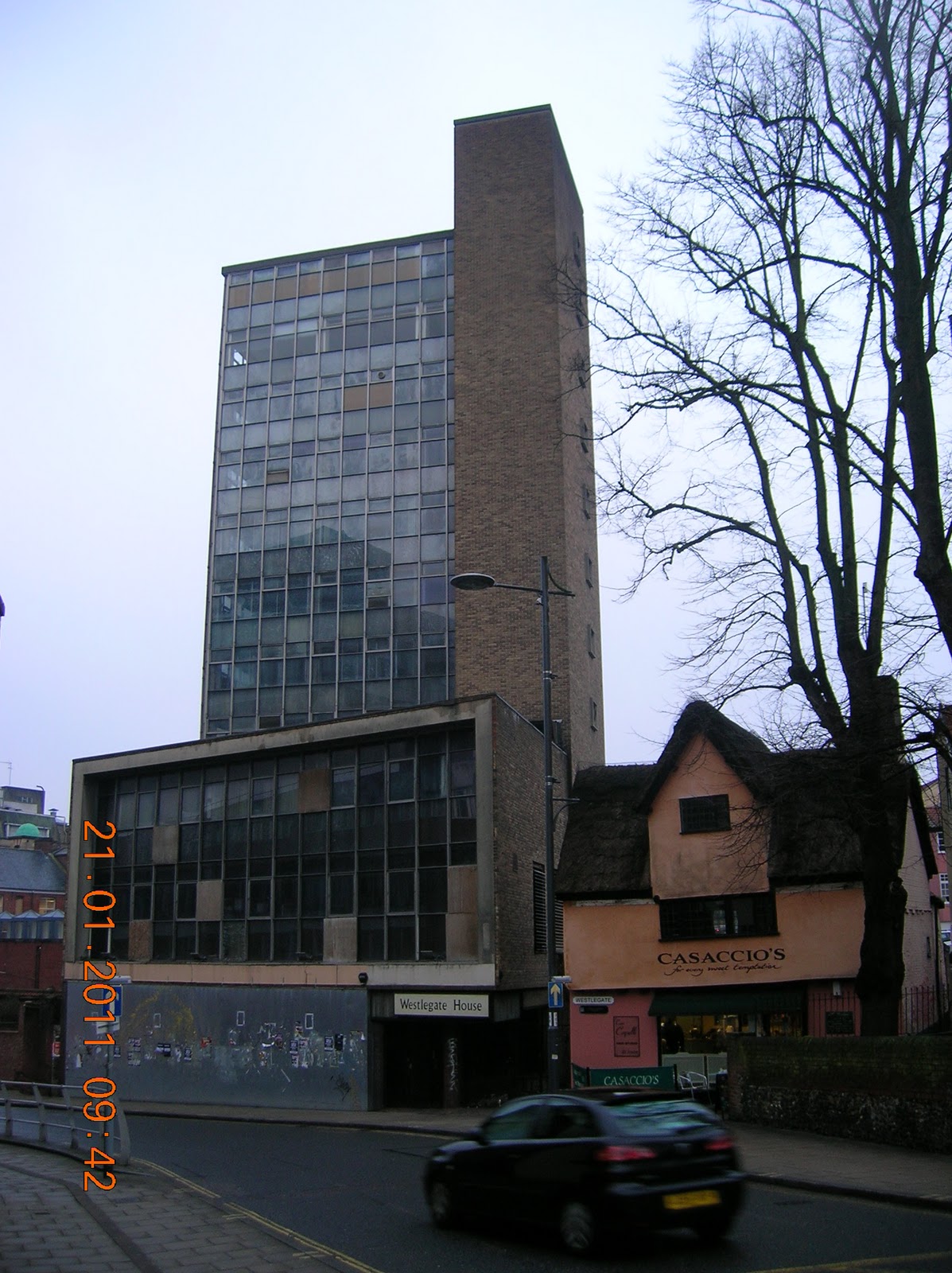
Ugly Norwich

Get the prozac ready: As dreary as the grey skies that sometimes hang over Norwich
("Heck!" said the architect, "there's not enough room for a door and a window, so I'll just make a little lean-to like so...")

What makes a building ugly? In this facebook album of pictures taken in Norwich it seems that one of the problems is context – buildings that would otherwise be passable become ugly blots in an inappropriate setting and this is certainly true in Norwich with its sometimes dissonant mix of old and new buildings: Modernism, functionality, and the hardnosed practical world of office and factory don’t sit well with the romantic, the quaint, the arcadian cottage, and the homely; we like to keep these two worlds apart (except solicitors). Other buildings however (see my picture above) would have a struggle looking anything but ugly in any context.

 I suspect that the overriding factor in determining ugliness is one’s mental context and the associations triggered by the building. Viz: What does the building signify to you? Does it trigger a sense of boredom? Does it look run down, neglected and dirty? Is it threatening in some way? Is it associated with danger? Does it signify either values or a life style you dislike? Get the mental associations right and a building can look beautiful: Perhaps even the building  I have pictured above, if rendered in brilliant shinning white and with flamboyant canopied windows, could look exciting and beautiful on a summer’s day; but it wouldn't be "Norwich".


City Office Block vs. Bucolic Cottage: Norwich is not well known for getting its building contrasts right

***

For centuries, perhaps since the rise of the merchant classes and gentry toward the end of fourteenth century,   the attitude to building in Norwich has been "Let's just do it guys!". In the doing we have been left a hotch-potch of monuments typical of an Anglo-Saxon market free for all. And yet unplanned and unsystematic though it is the net result of many architectural foibles can often be unconsciously quaint and charming. But sometimes, as we see above, this outcome is hilarious.

Thursday, 23 December 2010

Christmas Wonderland

Blickling Hall Sphinxes maintain their guard at the Temple Avenue entrance

Here are some seasonal photos of Blickling Hall grounds.

Wednesday, 24 November 2010

Creswell Crags


Creswell crags is a small limestone gorge not far from the Derbyshire peak district. Amidst the soft rolling landscape of a modern arable setting it cuts an anomalous and peculiar scar on the landscape (ignoring the far bigger scar created by the nearby opencast mining operation). But what makes the gorge stand out most is that it is a time capsule from an era far older than anything else I have yet dealt with on this blog.

During a recent visit to the Crags I was impressed by the depth of time this small Limestone gorge and its collection of caves represent. Quite apart from the geology of the crags (which presumably started with the formation of a layer of limestone strata in carboniferous times) the impressive human interest value of the site goes back many thousands of generations, right back, in fact, to over 40,000 years  ago when Neanderthals occupied the gorge. According to Creswell Crags’ wiki page its caves not only hosted Neanderthals but also saw phases of human occupation around 30,000 years ago and then again around 14 to 13 thousand years ago. The latter were seasonal hunter gatherers who arrived from the continent and used the caves during the cold British summer of a glacial interstadial. It was this latter group who left the recently discovered (2003) sensational cave art – sensational because it is the only known cave art in Britain.

The Paleolithic human prehistory of Creswell Crags makes the other ancient sites I have mentioned in this blog look more like memories of yesterday; even the Neolithic, Bronze Age and Iron Age structures of Britain are recent by comparison. From our perspective  a time of 13000 years ago might feel as though the benefits of the end of the ice age were just round the corner, but no; the end of the ice age was still 3000 years off and that equated to hundreds of generations of these nomads' short and hard lives; life as they knew it was going to continue for them just as it had for many generations before that. For these people each year was just another year in what to all and intents and purposes was an endless cycle. I doubt they had much sense of history. A sense of history requires, like a landscape, features to act as landmarks in order to give it character, identity, distinctiveness and a sense of time passing by. The concept of an historical progression may never have occurred to them

Given that today we are familiar with the idea of some kind of origin from which history unfolds and changes, it raises the question of just how a people trapped in a seemingly endless cycle viewed the world. What were their beliefs about the origins, nature and purpose of their world? Did they even have such beliefs? Whatever they believed, it would, of course, have been mediated from one generation to the next by an oral tradition that was propagated down the centuries and millennia. I tried to put myself in the position of one of these wandering cave dwellers: In the dark caves at night as sleep stole over them, did they have questions in their minds about their lot? Did they wonder if life had always have been like this and for how long? Did they wonder what life would be like thousands of years hence? Could they even conceive such questions? Or perhaps they were assured that their oral traditions provided all they needed to know and thought no more of the matter. When one draws back and imagines these people contemplating such questions, there seems to be as much chance of an ant crawling around on the face of a mountain grasping his full context. Or alternatively if our ant is the ant equivalent of a Young Earth Creationist he can postulate that the mountain is no bigger than a cosy ant hill and thus feel less lost in his surroundings.

Do the artworks at Creswell Crags give us any clues about the beliefs of these hunter-gatherers? Trouble is, the very meaning of the cave art is itself an enigma. All we can do is use our imagination and knowledge of similar cultures in an attempt to connect with these ancient peoples. The archeo-anthropologists are probably best qualified to speak on this issue: The cave art may have been a teaching aid for trainee hunters, helping them to identify their quarry, perhaps via some form of ritualized initiation. There appears, however, to be no cosmological questions addressed by their art: Only what was needed to survive in a harsh environment was upper most in the minds of these people.

The humble cave dwellings of the Creswell Crags nomads differs markedly from the other two places we visited on the same trip – the impressive Elizabethan Wollerton Hall in Nottingham and Castle Acre priory – both very modern constructions by the standard of this post. After the deep time signified by Creswell Crags, these places, which in comparison go back to times we know so much about, seem prosaic and commonplace. As a living space Wollerton Hall, in particular, is as far removed from the setting of Creswell Crags as could possibly be:


…and yet on turning a corner in this now museum I came across a sight that for obvious reasons reminded me sharply of Creswell Crags:


....yes, a row of trophies bagged by that now politically incorrect animal the trophy hunter. What was once common place necessity 15000 years ago, in later times became the privileged pass time of the rich in an agriculturally based economy. The trophy hunter displays his trophies because his respect for his quarry reflects some glory and dignity upon him. So perhaps this vestigial hunter instinct throws some light on the enigmatic cave art of Creswell Crags.

Saturday, 25 September 2010

Symbol, Legend and Destiny at Sutton Hoo

Whilst holidaying in the Colchester area for a few days the wife and I visited the Saxon Ship burial site at Sutton Hoo. The 7th century site is the nearest thing we have to archaeological evidence of the first king of England, possibly the Anglo-Saxon king, Raedwald.

The Sutton Hoo area is the stuff of legends and those legends have given it a reputation for mystery, the sinister and even the preternatural. The circumstances surrounding the discovery of the Sutton Hoo treasure were initiated by the visions of a psychic on the eve of the second world war, circumstances which helped recall the legend that King Arthur would return from his grave in his country's hour of need. Arthur may actually have been a Celt battling against the invading Saxon’s but the language of myth and legend does not make fine distinctions; rather it is the vague associative and symbolic language of dreams. Perhaps because a pagan ambiance still haunted the mounds of Sutton Hoo it seems to have become an execution & burial ground for miscreants during the mediaeval 9th and 10th centuries. Much later in the 20th century the general area had a military presence with all the associated inscrutability of the armed forces. The wider environs played host to the famous Rendlesham forest UFO incident of Christmas 1980.

Truth, legend and myth form an inseparable union at Sutton Hoo. When the Romans left Britain in AD 410, the commentary of history was interrupted for a while and an information black-out descended. When history did eventually re-emerge in Bede’s writings we find Anglo-Saxons inhabiting these Islands. The Anglo-Saxons connect Britain to Iron Age prehistory via their link with migrations from the continent. Effectively then, the “dark ages” represent a time when prehistory almost reasserted itself in England.

When I look at the mounds at Sutton Hoo, which have been deliberately constructed high above the Deben Estuary to be visible*, I wonder if their connection with prehistory might throw light on the beliefs of the much more distant and mysterious pre-roman cultures who pockmarked Southern England with many earthworks. Ultimately, however, Anglo-Saxon “prehistory”, cheated the black-out of the dark ages and emerged via the back door: When the Anglo-Saxons became Christianized and learnt to write, their oral traditions were caught in the net of history by a new generation of Anglo-Saxon scribes such as Bede. A few words of history (or even of legend) is worth a thousand archeological artifacts.

The oral traditions of the Saxons, which would have been told and retold in the heady fireside atmosphere of their thatched halls, may not be the most reliable of sources. Moreover, Bede glorified this history by depicting it as the out working of destiny rather than serendipity. But to be fair to Bede when history is observed retrospectively it does look like destiny; we can see the precursors and antecedents that the chaotic vicissitudes of time uses as the seeds of great things. It is very tempting to feel you are part of a people destined for greatness as the story of Israel indicates. Small beginnings are thus glorified. To Raedwald's subjects his glory would be easy to interpret as part of a Divine plan, although in the context of his times he is seen  to be a small time king. But in the wider perspective of world history he is not insignificant: In Raedwald prehistory was emerging into history and paganism into Christianity; these were the seeds of the world to come. That the minor language Raedwald spoke was in due course to become a world language propagated by a seafaring nation is fittingly portended in Sutton Hoo’s burial ship. Thus the events in this corner of the England 1300 years ago stand in the main stream of English history, even world history. As the National Trust guide to Sutton Hoo says:

...they formed the nation which fought under Harold II at Hastings in 1066, were ruled by Norman Lords, and were gradually awarded rights by royal charted and won them in Parliament. Gathering with other ancient peoples, they made Britain a world power.

The Anglo-Saxon governmental ethos eventually merged with that of the Normans to give us the institutions of a country that lead the world out of rural arcadia into the modern industrial age. It is thus very easy to impute mystique to the site at Sutton Hoo and see the portents of destiny. This in turn helps fuel the legends which surround it; from the ghostly psychic visions to those close encounters of the second kind.


Gulls wheel over the mounds at Sutton Hoo during our visit


* "Hoo" comes from "haugh", which translates as "high"

Friday, 10 September 2010

Modern Norwich


I used to think that modern Norwich would one day look like this.

Ostentatious Norwich , quaint Norwich , now modern Norwich. All the buildings in this latest Album have been constructed in my life time, from the late fifties onwards. I remember being excited as a child seeing these smooth and clean lined modern buildings going up. I easily and enthusiastically connected with modernism; in fact if I had had my way old Norwich would have been flattened and something looking like a city from the old Dan Dare adventures thrown up in its place. Modernism, to my mind, was all about a potent and formidable functionality. Why was there any need to indulge a taste for quaint and finicky filigree when the best art were these structural conquests demonstrating a mastery of science and technology. A towering wall of steel, glass and concrete was not only the best symbol of that conquest but it was also the best form of art. The elegant repeated sequences set up by many floors and windows spoke of the elementalism, order and precision of mathematics. Fourier was right: From this simple periodic pattern all functions could be constructed. An elemental mathematical periodicity was the key to the universe.

One of the first modern buildings in Norwich

Norwich by modern standards is not a big city and neither are its buildings very large, but in the 1960s the common 17th 18th , 19th century vernacular buildings of Norwich were being dwarfed by constructions that in comparison seemed huge especially to a child. There is a line in H.G. Wells' "The Time Machine" that expresses it well for me: The Time Traveler is on his machine as it plunged into the future and he describes what he saw:

… so with a kind of madness growing upon me, I flung myself into futurity. ..presently a fresh series of impressions grew up in my mind – a certain curiosity and therewith a certain dread – until at last they took complete possession of me. What strange developments of humanity, what wonderful advances upon our rudimentary civilization, I thought might appear when I came to look nearly into the dim elusive world that raced and fluctuated before my eyes! I saw great and splendid architecture rising about me, more massive than any buildings of our own time…..

As I read that passage as a teenager I no longer wanted to be Dan Dare, but Wells’ Time Traveler instead. Just like the Time Traveler I was seeing the future fast developing around me. But as I read further into the book I was in for the shock that Wells had carefully prepared for his readers. The Time Traveler eventually emerged into a world that cut across his expectations and which he struggled to understand; yes, technical advances had been put into place but paradoxically and ironically they had brought about a humanity that had “devolved” into two competing species; the whimsical Eloi and the practical Morlocks. Both species were a shadow of their distant ancestors. The Time Traveler called it the “Sunset of Mankind”. Just like the Time Traveler I too found a strange place waiting for me in maturity; the Eloi vs. the Morlocks was a fine metaphor for the heart of man vs. the head of man, a dichotomy everywhere to be found.


Norwich Today: Is that Dan Dare's Rocket I can see?

Saturday, 28 August 2010

The Haywain


The Haywain by John Constable

I was brought up with a copy of John’s Constable’s Haywain (see above) hanging in my parents’ lounge. As a child I was puzzled why a wagon and its horses should be driving down the course of a small river; or was it stationary? Other than that I gave the painting little thought, although I did unconsciously imbibe the mood of peace, tranquility and beauty that the mind, unbidden, attaches to it. I have a modicum of artistic skill but art has not been my area of study, so unsurprisingly it is only in the last few days I have discovered the solution to the riddle of Constable’s evocative work.

Recently I happened to be in Ipswich, helping to escort my wife’s Spanish students. We visited Christchurch mansion where there is a display of Constable’s paintings. At the end of my visit I purchased a small book on Constable’s work by Ian St. John (entitled Flatford, Constable Country). According to St. John the Haywain is fording the river Stour from the near bank (where wheel ruts can be seen entering the river) with the purpose of collecting sun dried hay from the meadows over the river. Corn reapers can, in fact, be seen working in the distance. St John also points out those easily ignored disconnected incidentals which richly and randomly embroider real life: A fishermen can be seen coming through the undergrowth on the far bank to his moored boat and a kitchen maid is on the landing stage of Willy Lot’s house collecting water.


Christchurch Mansion, Ipswich, houses the largest collection of Constables outside London.


As far as I’m concerned, however, there remain riddles in composition of the The Haywain: The wagon and its team of horses doesn’t seem to be taking the most rational course to the other bank; according to St. John they are heading for the right hand fork of the river and thence up onto the bank. To my eye there is an awkward discontinuity in the trajectory of the Haywain and I suspect this is because elegance of composition was the overriding factor in Constable’s mind; for example he laterally compressed Willy’s Lot's cottage to bring in to the painting a more varied roof line thus improving composition.

Constable’s painting is a snap shot of arcadian life in the early 19th century. The stasis and silence of paintings whatever the content, dresses the subject with a peaceful ambiance and even more so if the painting depicts a rural setting. However, in spite of the idyllic content of the painting and the apparent aimless deportment of the Haywain itself the subject matter is, in fact, very dynamic: Constable’s rural contexts depict the countryside as a place of work. In the early 19th century that work was in many cases hard and long and I suspect its workers hit their beds at the end of the day very ready for sleep. I’m reminded of Darwin’s statement to the effect that the seeming tranquility of country hedgerows hides an unseen struggle for survival.

But the inhabitants of Flatford where the Haywain was painted were, I suspect, more placid than we are today: Although there were justifiable rebellions in the face of poverty (e.g. the Swing riots of 1830) their society had only just started on the road to industrialization and they did not know that plenty, like poverty, can also cause vexation: Contemporary media and advertising allow comparisons to be made between peer groups, raising expectation and the desire for status & one-up-man-ship; there always seems to be something better to attain or gain, especially as the apparent social mobility of modern society suggests that the opportunity for extraordinary levels of betterment are in principle open to all. Restlessness leading into outright discontentment is inflamed when expectations are dashed. One might own a 50 foot luxury yacht, but a nagging angst can set in if most of one’s peer group own 100 foot yachts. And when one does achieve one's goals of wealth and status there is a strong desire to hold on to them, at all costs. (Phil 3:7-12) *

But the composure of the arcadian idyll didn’t equate to a lack of self-awareness. Constable stood back and took stock of his conditions of existence through his art. Naturally enough for an artist like Constable his appraisal was intuitive and instinctual rather than analytical. Remarking on his painting called “The Lock” Constable wrote:

..its light cannot be put out, because it is the light of nature – the Mother of all that is valuable in poetry, painting or anything else – where an appeal to the soul is required. The language of the heart is the only one that is universal.

Constable’s paintings attach a sense of beauty, grace and dignity to the workplace that was Flatford and  glorifies it. These very human qualities are less an intrinsic property of the situation-in-itself than they are an extrinsic property arising from the atmosphere our minds impute to that situation. Mood is, as Constable suggests, the language of the heart and mood is more easily conveyed by art rather than by science. In the case of The Haywain, the enigmatic and seemingly purposeless orientation of its wagon and horses adds to the ambiance of composure and serenity.


Willy Lot's Cottage and the Haywain ford today.


* Footnote: It is reckoned that the hill forts dating from the iron age which pockmark Britain were a response to  growing agricultural abundance. This abundance provided the opportunity for the ambitious to compete with their peers in the control of that abundance. Once control was achieved there then arises the need to hold on and protect one's wealth and status from the grasping hands of one's fellow humans; the hill forts were a means to this end.