Showing posts with label politics. Show all posts

Tuesday, 16 September 2025

Beeston Castle and Basing House. Part II

(See here for part I)

Basing: House: Siege of Basing House 1642 to 1645 during 
the English Civil War. See here Siege of Basing House


The ruins of Basing House are situated on a modest salient just outside the village of Basing (Near Basingstoke). Basing House, like Beeston Castle was initially conceived as a Norman motte and bailey fortificationbut the environs of Basing House are no scenic match for the high rise epic landscape of Beeston Castle. Basing House, however, compensated for its relatively low relief landscape by reaching social heights that Beeston's functional garrison castle couldn't hope for. During the 16th century the courteous social climber and owner of Basing House, Sir William Paulet, spent a fortune rebuilding the Norman site and ended up with what was arguably the grandest mansion in all England, although it is now largely reduced to its foundations. The guide book tells us.....

 It is [now] hard to imagine that it was once "the greatest of any subjects house in England, yea larger than most of the King's palaces"

Paulet became Earl of Wiltshire and Lord Treasurer of England in 1550 and a year later the Marquess of Winchester. Such was his social climbing success that the guide book can quote Francis Alen the Earl of Shrewsbury who in 1560 said: 

"The Queen [Elizabeth] so liked the house of the Lord Treasurer at Basing and her entertainment there that she openly and meryly bemoaned him to be so olde, for else by my trouthe (sayeth she) if my Lord Treasurer were a young man I could fynde in my harte to have him to husbande, bifour any man in Englande".

Even the much younger Lord Leicester of the fashionable and elegant Kenilworth castle who openly tried to court Elisabeth failed to get a similar compliment. Born in the 1470s Paulet died in 1572 which means he must have been in his nineties, a remarkable age for that era. 

The original foot print of the castle wasn't big enough for the ambitious Paulet and he extended his property by building the New House which was appended to the the original Norman Motte and Baily site. The New House can be seen at the top of my photograph of this model of Basing House....

Model of Basing house depicting how
it looked before its destruction


After Paulet's death the site went into decline, but at the start of the civil war in 1642 it was refortified as a royalist garrison because of its strategic location on the main route to the west country. In 1643 it came under parliamentary siege. Although primarily a house and mansion rather than a castle it was a surprisingly difficult nut to crack and the parliamentarians made several attempts under different commanders to capture it. Finally under the command of Colonel John Dalbert and none other than Lieutenant General Oliver Cromwell, the House fell with the New House proving to be its Achilles heel. See below for an artist's picture of the siege...


The siege of Basing House: The first mansion is on the
 left; its curtain wall follows the circular mound of
the Motte. The New House can be seen on the right. 


After the siege the house was offered as a quarry for the inhabitants of Basing to help rebuild their devasted town. It is no surprise then that little of the original house remains, although the large scale of the still intact Great Barn gives a feel for the red brick glory of the original mansion....

The Basing House Great Barn: I've never seen an old barn
this big: It almost felt aircraft hanger size.

All that is left of Basing's grand dinning hall is its wine cellar. The dinning hall was no doubt the scene of many an aristocratic banquet. Those banquets would be the setting for a mixture of social climbing, connection building, gossipy intrigue and discussions about the latest affairs of state. It was a place to keep your social masks on but those attending probably felt pleased knowing that their presence proved they were on the top rungs of society's status ladder. 

All that is left of the great banqueting hall;
the wine cellar underneath. 

In the nearby oven rooms & kitchens the hoi polloi worked very hard to keep their snobbish betters pleased by serving up lavish vittles. The oven room where they worked would have been a very hot and unpleasant environment; a nearby interpretation board tells us that a Spanish visitor in 1554 described Basing's kitchens as "...veritable Hells such is the stir and bustle in them".

What remains of Basing House's kitchen ovens


Reflection

As I stood on the edge of the open cellar which is now all that is left of the Great Hall and looked at the nearby ovens I became aware of the meaning and apt symbolism of this now ruin of devastation along with its departed culture. It harked back to a day when a privileged upper ruling class, the aristocrats, was taken for granted to be part of the natural order of things. Today, needless to say, high privilege is looked at askance as perhaps an unjust anomaly in what should be the moral natural order of things. How has that change come about? One man to ask is Oliver Cromwell....

 As a show piece of upper class excellence and aristocratic self-satisfaction Basing House had few rivals, although its halcyon days lasted not much over a 100 years. How fitting then that it was Oliver Cromwell, a man of the earth who styled himself as a humble agent of God's people should take part in bringing judgement to this extravagant seat of privilege. But Cromwell was a fundamentalist by mentality and was full of the certitudes of righteousness, a dangerous condition which so often afflicts religious zealots. Nevertheless, as I have remarked before, Cromwell had pioneering ideas about government by parliament but he failed to implement them. He failed to implement them because a man of such decided religious conviction was simply unable to accept that given our very human tendency toward self-interest and our epistemic limitations, government by argument (as opposed to government by ruling class diktat) and government by agreeing to disagree was the inevitable norm of a genuine parliament. So, in all his fundamentalist self-confidence Cromwell could not accept a quarrelling parliament of ordinary human beings and regarded them as too unrighteous to rule; that is, all except himself of course! So, although he rightly didn't have the gall to accept the crown he nevertheless became the "righteous" dictator who ruled with an arrogant certitude. 

Simon De Montfort, Earl of Leicester is also credited with conceiving the idea of a parliamentary democracy. His and Cromwell's ideas were moving in the direction of democratic accountability but ultimately they both muffed it. De Montfort was to the Jews of the country as Cromwell was to England's Catholic community; both leaders unleased terror upon their identified pet hate group, a group they regarded as a conspiratorial cartel of the wicked and who therefore became objects of blame and persecution. Cromwell's and De Montfort's jealously held certainties may account for them both failing to implement a true parliamentary "rule by argument and disagreement" government (but constrained by a constitution). It wasn't until the days of King William III that things started to move in the right direction.


Appendix

This photograph shows a breach in the curtain wall of the Old House allegedly made during the parliamentary siege..

Saturday, 6 July 2024

Visit to York: The End of History Experience Part II

 See here for Part I

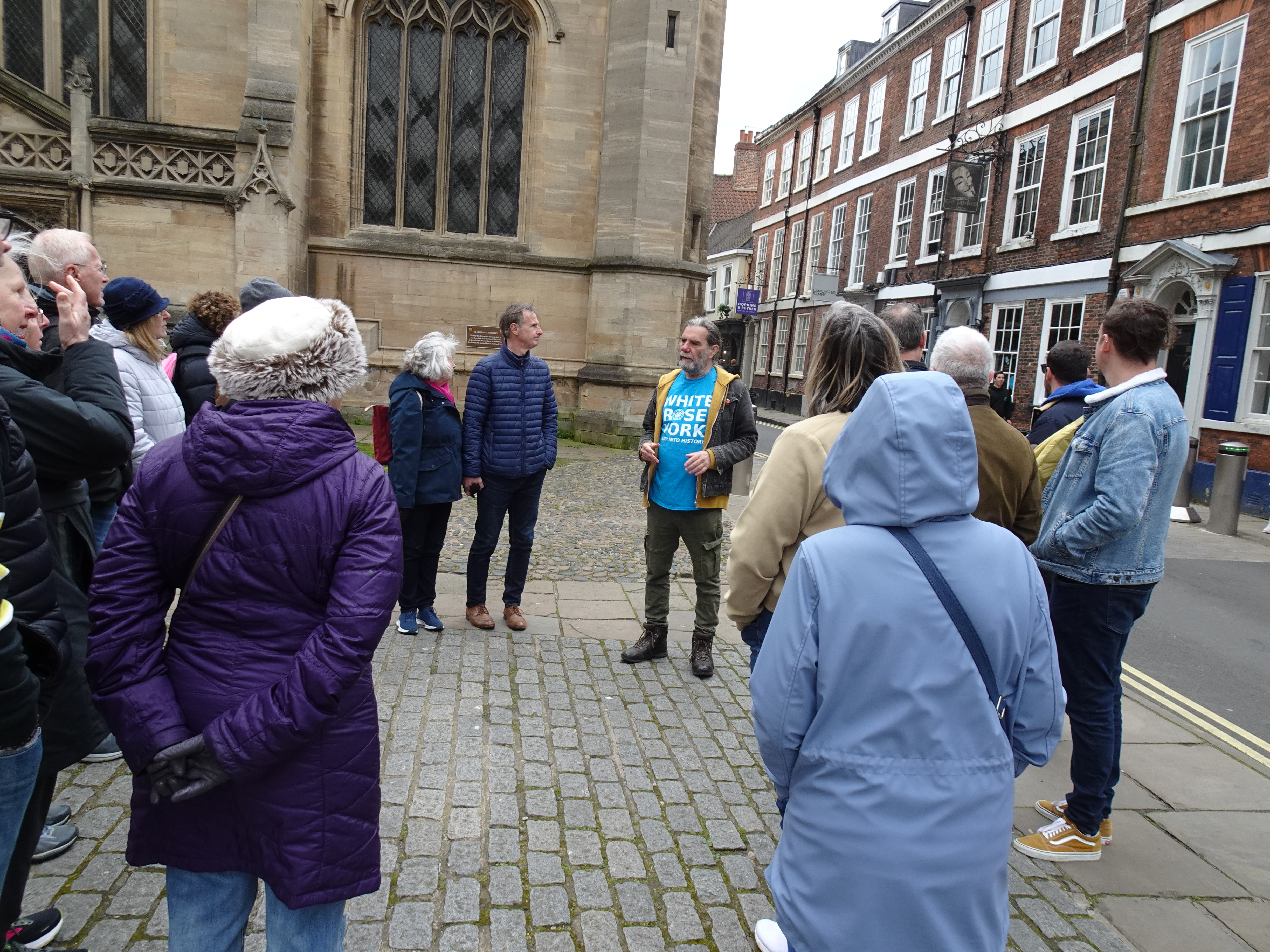
The excellent White Rose Tours. 
White Rose York Tours « Home of York's finest free tour – Daily at 11am and 3pm

One of the first things we did during our one-day visit to York was to go on the highly acclaimed White Rose Tour (See above - I would recommend this tour). This provided an excellent overview of the History of the City of York, from Roman times through King Charles I convening his court outside the city gates to the recent confectionary industry in the city.  Given some of the changes, traumas and brutality the city has witnessed it help reinforce my not entirely rational feeling that either history had ended or that I was simply a detached onlooker for whom history didn't happen. 

Coming from Norwich, a city which according to Wiki claims to be the most complete medieval city in the United Kingdom, it was inevitable that I'd compare York with Norwich. They have similar population size, but Norwich is far more sprawling & has undergone haphazard modernization. As a result, York gives the impression of being more densely packed with history than Norwich, especially in the famous "Shambles" area.....


The Shambles, York. 

The original fortified Roman town of York is buried under the center of the modern-day city and therefore has a largely archeological presence. This contrasts with Norwich where the nearest Old Roman town is five miles south of Norwich at Caister St Edmund. At Caister there is a very visible square embankment along with some remaining Roman walls. Norwich was founded by Saxons at least one hundred years after the Romans left York. Unlike York I'm not aware that the ghosts of Roman soldiers have been sighted in Norwich, although it is claimed that a Roman crossroads existed in the Charing Cross area of the city.

York has a huge claim to fame in the annals of Western history; namely, that Constantine the Great was declared emperor by his troops in York after his father (the emperor at the time), died in 306 whilst staying in York. I don't think Norwich has so significant a claim to being on the critical path of Western and European history. In the civil wars which often accompanied the succession of Roman emperors Constantine was eventually victorious and became the official emperor in 324. In 325 he presided over the council that gave Christian history the Nicaean Creed, a creed which has so influenced Christian thinking since. Constantine can therefore claim to have set the conceptual and geographical mold for European Christianity which has affected belief and politics right up until the present day with its division (and tensions!) between Eastern orthodox Christianity and the Western expressions of an abstract Christian ethos.  As one walks around the quaint streets of York it is difficult to believe that critical path events took place here profoundly affecting the evolution of both European and world events.

A very imperial looking statue of Constantine with the
 Minister walls in the background


Constantine and Europe's religious foundations.


But before all that happened York was to pass out of Roman influence and the remaining Romano-British faced Anglo-Saxon migratory infusions followed by Viking conquest. The Vikings took over the city of York in 866 (As they did also Norwich). The Jorvik experience with its animatronic Viking tableaus (which include the unpleasant smells of the time!) provides the detached end-of-history observer with a life-like almost time machine experience of the Viking past. With its smells & noises it is a very visceral experience. In fact, it reminded me of one of those fairground rides that takes you into the depths of another world. It was dark like the ghost train except that this wasn't fantasy: This was Danelaw Britain circa 800 AD and I was looking at ghosts from our past.  

One can't help but measure up Danelaw living conditions with our own "end of history" standards. To the comfortable 21st century UK citizen to whom even Roman life seems very uncivilized, the Viking context is intolerably primitive and squalid.  However, it is no doubt true that history has been unkind to the Vikings: Their history was largely written by those highly literate and learned Anglo-Saxon monks who were on the receiving end of ambitious Viking savagery.  And yet it was clear to me from some of the exhibits at the Jorvik Centre that Viking metalwork was much more advanced than the rumored history I was acquainted with would give credit for. In particular I was very impressed with a Viking padlock, and I spent some time studying it. 

Real Viking ghosts!
Travel back to Viking times at the Jorvik Center in York


But even the Vikings eventually converted to Christianity's compelling revelation of a God of sacrificial giving and love. In fact, one tableau was of a Viking Monk giving the Christian last rights to an old woman as she died not in battle but in her bed. Given Viking maritime culture the patron saint who naturally appealed to them was St Clement, the martyr who was executed by being tied to an anchor and thrown into the sea. So even the jingoistic Vikings who reveled in force of arms and reckless brutal courage started paying at least lip service to the Christain revelation of a God of voluntary vulnerability & sacrificial love (Philippians 2:1-11). How ironic. It was these people along with other European cultures who were to eventually bring riches and advancements that they couldn't possibly imagine at that time. So, we can thank these primitives for their adventurousness, ambition and above all their conversion to Constatine's faith. Amazing. Unbelievable. Beyond remarkable.

***

The highlight of our visit was of course York Minister. It is the largest gothic period cathedral, bar one:

The present building was begun in about 1230 and completed in 1472. York Minster is the largest cathedral completed during the Gothic period of architecture, Cologne Cathedral only being completed in 1880, after being left uncompleted for 350 years. (Wikipedia)

Because of its size in cramped York surroundings, it is
 difficult to find a space where one can stand back far enough
from the Minister to get the whole building in one frame.

In this cavernous interior the medieval mind would have
 boggled at the paradox of God's overwhelming and intimidating
glory when set against the miracle of His voluntary
self-abasement as recorded in Phil 2:1-11

As I looked heavenward this view gave me vertigo!
Perhaps the architect would have said "Good,
it is meant to!"

So much about York Minister is record
breaking, like for example this huge 
east end window, bigger than a tennis court.


York Minister may well have been built on the top of the very spot where Constantine the Great was declared emperor by his army; that would be a fitting tribute and crowning glory to Constantine's conversion to Christianity. This conversion turned out to have momentous historical consequences and of such import that it perhaps even left a disturbance in the psychic field around York, thus explaining the well-known ghost sighting of Roman soldiers in the basement of the Treasurer's House! (See also here). After all, if I'm right about the nature of conscious cognition, reality isn't "out there", but "in here"! Are apparitions evidence that reality sometimes malfunctions and expresses itself as a kind of reified dream state?

One has to admit that not that many conversions to Christianity are followed by all together exemplary lifestyles: Highly self-motivated Christain kings seeking personal glory continued to fight, squabble and build empires by force of arms, often quite sure they were meeting out the judgement of God. (But then I continue to sin myself, mostly sins of omission I think).  Perhaps the effect of Christianity is a slow burner effect: We are still a long way from peace and social harmony, a harmony that is metaphorically well represented by York Minister's glorious round west end window:


What medieval mind invented this wonder? But like
other gothic structures it probably evolved bit by bit. 

Is the medieval Cathedral building period the zenith of Christianity, a Christian culture whose tide has since turned as Matthew Arnold's poem Dover Beach would have it?  Ironically the individualism of Berean self-criticism (See Acts 17:10ff) which the protestant revolution unleashed is, I propose, implicated as the main cause of the turning of the tide of the Sea of Faith. The individualistic self-analysis and self-criticism encouraged in the Bible easily turns to criticism of others and when it is supplemented by the doctrine of the power of the laity it follows that every voice is a good as everyone else's voice. So, given humanity's epistemological challenges the very natural outcome of protestant Bereanism is that self-aware critical analysis should ultimately be brought to bear on Christianity itself. The power put into the hands of the laity by the protestant reformation has in turn lead to a slow burner revolution which has ultimately entailed that a take-it-or-leave-it opportunity be applied to Christianity itself and in consequence many have left it. This outcome, ironically, seems to be the ultimate outworking of Protestantism. But at least it means that in the democratic West no one is badgering one about the state of one's faith, whether it be one of belief or unbelief. So perhaps this very freedom of faith is the ironic pinnacle of Christianity? But today this private working out of one's personal salvation is in danger from traditionalist authoritarians and autocrats residing in both the east and the west.

Friday, 6 August 2021

A Visit to the Isle of Ely Part III: Oliver Cromwell

My photograph of Oliver Cromwell's house in Ely

(See Part I here and Part II here)

Historians of the Seventeenth century will know that Oliver Cromwell's house, the one in which he lived and worked between 1636 and 1647, is within an arrow's flight of the huge monument to medieval Catholicism that is Ely cathedral.  Cromwell in many ways stood for everything that Ely Cathedral was not. The puritan Celia Fiennes was typical of  Cromwell's puritanical strain of thought:

When Celia Fiennes recorded her visit to Ely in 1698, she could remark, "this church has the most popish remains in its walls as any I have seen" (Ely Cathedral guide page 20)

As a mere dabbler in history I have to confess that I didn't know that Cromwell's house was so close to the Cathedral until I visited Ely in the warm September of 2020! But coming to this fact for the first time in my life meant that I was blown away by the surprising and hugely ironic juxtapositions of these two buildings, both monuments to two very disparate expressions of the faith. Cromwell so epitomized the austerity, the business-like practicality and lack of finesse & decorum that goes together with the resurgence of middle-class puritanical devotion of that day.  According to the Cathedral guide:

The puritans rejected all but the plainest forms of worship - in a letter to the Precentor, Cromwell described  the choir service as "so unedifying and offensive"  - and during the Commonwealth, Ely  ceased to function as a Cathedral. 

Cromwell's reaction to the Cathedral and its form of devotion is nothing but what you'd expect from him. 

Progressively, Cromwell had moved into a popularist position where he had gained the influence and authority to implement his brand of idealism:

Oliver who had undergone a religious conversion in his late twenties believed himself to be one of God's Chosen People or Elect. He was fiercely critical of High Churchmen, like Matthew Wren, Bishop of Ely and of authority generally, defending the rights of the fenmen against  those who sought to drain their land without adequate compensation. The popularity and support that he won from those whose cause he defended earned him the name "Lord of the Fens". In 1640 Cromwell was elected MP for Cambridge and so became increasingly involved in national affairs.  (Guide to Cromwell's House page 2)

Here we see the beginnings of that common political phenomenon where a popularist rebel against established authority (who may otherwise have a just cause) eventually maneuvers themselves into a position of established authority without any sense of irony.  In fact after the 1642 civil war Cromwell became an absolute authority:

During the disturbances of the Civil  War in January 1644 Cromwell warned Mr Hitch, the Precentor of the Cathedral "Lest the souldiers in any tumultuary or disorderly way attempt the Reformation of the Cathedral Church, I require you to forbear altogether your choir service, so unedifying and offensive....". Hitch ignored the warning so Cromwell saying that he was "a man under authority" ordered him to "leave off your fooling and come down"; Cromwell then drove out the congregation. In 1649 Parliament ordered an inquiry into the possible demolition of the Cathedral, which was in a decayed state, so that the sale of the materials might be applied to "the relief of the sick and maimed soldiers, widows and orphans". The Cathedral survived  only because the cost of demolition was estimated as greater in the value of the materials remaining. but was almost certainly closed for about seventeen years. (Guide to Cromwell's house page 5)

The take home lesson here (as if we didn't know already), is that fundamentalists and idealists have no mercy if it cuts across their ideology; ideology first, grace second, if at all. The architectural wonder of Ely Cathedral only survived because practicalities made it too expensive to demolish!  (Let's recall how ruthless the Taliban and Islamic state were toward the heritage of the past). Notice also the time honoured tension between the cost of the monumental and the cost of servicing the less fortunate.

For me Cromwell is a frustrating figure who missed his opportunities for true reform because of his uncompromising idealism; his obsessive anti-Catholic ideals drove an unbending sometimes merciless  agenda. It is axiomatic to idealists and fundamentalists of Cromwell's ilk that critics are assumed to have hidden and malign motives for disagreeing and therefore justifiably dealt with by coercion. Cromwell's self-belief meant that he could see no irony in his wielding absolute authority and in his willingness to use the threat of lethal force, a threat which he excused with the euphemism of "being under authority". He used that threat to drive out Ely's congregation and later squabbling parliamentarians. He became head of a joyless dictatorship that was consequently all too open to a reactionary return to the very things he opposed. But in spite of all that I believe Cromwell had the right idea at least in a theoretical sense; that is, of a parliamentary forum for the common people; but for him only those common people of sufficiently puritanical frame of mind, else he was liable to exercise his "authority". Like idealists the world over Cromwell didn't see that as a sinner he was as much part of the problem as the solution. If he had seen that he might have understood that there is little choice but to work with a morally and epistemically compromised humanity. He might have also understood that a squabbling often corrupt  parliament with a tendency toward selfishness was, as Walpole observed, the natural state of human affairs and must be wisely managed & regulated rather than engaged in a futile struggle to eradicate sin - only God can do that. 

But then the mitigation for Cromwell was that this was early days in the democratic experiment and I suppose a lack of understanding of what real democracy actually looks like in all its messy compromised & argumentative untidiness would have been beyond an idealist who faced the conundrum of all idealists: That is, as the French revolutionaries discovered, the full implementation of an ideology can only be achieved under totalitarian conditions; the very thing many idealists see themselves as rebelling against.  Underneath it, however, I believe Cromwell was not motivated by a desire to seek power and he refused the crown. He genuinely wanted power to be in the hands of the commoners, but at that stage in British history he really had no idea how to implement his vision among sinners and his fall back was his own sense of being right and his willingness to use diktat.  That a noisy contention is a necessary concomitant of true democracy just seemed wrong, wrong, wrong to a buttoned up puritan. I'm tempted to accuse him of being a block-head, but I'll refrain; it's easy to criticize Cromwell in hindsight. 

***

Move on 200 years into another age, the 19th century, and we find the romance of the gothic revival in full swing. The attitude profile had changed; at least in some quarters. The gothic purists found the abuse of the fabric of Ely Cathedral as equally offensive as Cromwell found the Cathedral services of his day: According the the Cathedral guide:

The architect and chief protagonist of the Gothic revival in England, A. W. N. Pugin, on walking into the Lady Chapel, is said to have burst into tears exclaiming, "O God, what has England done to deserve this". 

The Cathedral underwent restoration in the early Victorian period. These post-enlightenment people who were now well into the age of the mechanical, the industrial and the intellectual had acquired a taste for the mysticism of ritual and symbolEly Cathedral as a suitably atmospheric & monumental venue serving these tastes suited them down to the ground.

***

In Mat 7:13-14 we read:

“Enter through the narrow gate. For wide is the gate and broad is the road that leads to destruction, and many enter through it. But small is the gate and narrow the road that leads to life, and only a few find it."   

The ways to destruction are many, the ways to life very few; (that sounds like a consequence of disorder theory to my ears!). I would question whether sinners ever find that gate at all; rather it is found for them and revealed to them by a God of Grace.  

The path of human salvation goes through the narrow gate of the Cross, but the path to ultimate salvation (as Bunyan discovered) is a winding way, perhaps even a maze, as the complexities of Christian history testifies. Let me finish this post with these words taken from the Ely Cathedral guide as it comments on one of the millennium sculptures found in the Cathedral:

Adjacent to the labyrinth and complimenting its symbolism, is Jonathan Clarke's The way of Life [sculpture]. It is cast in aluminium with nine sections, each differently jointed. Like the journey of life, its path in irregular and unpredictable and as the journey is sometimes hard, sometimes joyful, so the surface texture and the colour also vary. Perhaps to give a human scale to the journey Jonathan Clarke placed a tiny human figure on the top arm of the cross. (See below)

To me it's also a metaphor for the journey of Christian history itself with its motely mix of heroes, sharp minds, successes, reverses, eccentrics, extremists, fundamentalists, cultists and woolly thinkers (They know who they are!)

Clarke's Way of Life sculpture

I'd call this the Maze of Life, with its dead-ends, opportunities, surprises and openings. 

Thursday, 10 June 2021

A Visit to the Isle of Ely. Part II: Alpha Females

See here  for Part I of this series. 

The guide to Ely Cathedral tells of the founding of Ely as a monastery for men and women:


It was said that the body of St Ethel
was was discovered uncorrupted in
her shroud. She seems to have lost
her breasts too. 

Etheldreda was the daughter of Anna, Saxon King of the East Angles and like her father became an ardent Christian.,,,,She always felt called to the religious life, but for political reasons she was married first to Tonbert, leader of the people called the South Gyrwas, who gave her land and royal rights to the Isle of Ely. 

Tonbert died and Ethel married Egfrid heir to the kingdom of Northumbria. The marriage was unsuccessful and Ethel became a nun. She escaped Egfrid's unwelcome attentions by isolating herself on the Isle of Ely where in 673 she founded a double monastery for men and women. Ethel was abbess at Ely for seven years before she died. 

Sometime after Ethel's death stories circulated that her body was moved and in the process discovered  to be uncorrupted and was a source of healing miracles. Well, needless to say I don't believe any of that; not that I think miracles don't happen, but you can't trust some human beings to transmit reliable accounts about such things and I tend to use a "guilty until proved innocent" criterion when assessing these stories.  But what I do think is behind Ethel's story is that of a female frustrated by the strictures of the role forced on her by the male dominated society of the day. When her style wasn't being cramped Ethel was by nature a mover and shaker. In spite of the times, however, she nevertheless managed to find a way to express her character in one of the few avenues open to females with aspirations, thereby leaving her mark for posterity: She founded a monastery at Ely and became an abbess and saint. In an indirect way it is to St. Ethel we owe the marvellous experience that is Ely cathedral. 

A theme of  women of strong character & influence impacts the Cathedral at several points not least the Lady Chapel attached to the north side of the presbytery. Of this the guide says

The thirteenth and fourteenth centuries were notable for the rise of the cult of the Virgin Mary, especially in England. Lady chapels in her name were added to many churches....The Lady Chapel of Ely is exceptional....completed in 1349 having taken 27 years to build....it is notable for the richness of its decoration, particularly that of the wall arcade, at the time the most elaborate to have been built in Europe....When it was completed the chapel looked very different to how it is today. It was highly coloured, the windows were alive with stained glass and there were painted statues in the niches.

No doubt much ink has been spilt eulogising the ornate carving and elegant gothic architecture of the Lady Chapel. I can't usefully add to those accounts other than to say that even today the chapel needs to be seen to be believed. But there is one big fly in the ointment that everyone remarks on: All the heads of the delicate statuary have been knocked off. This was the achievement of bishop Thomas Goodrich shortly after Henry VIII turned against Rome. But Goodrich u-turned when the Catholic Mary I become queen (no doubt for his own safety). Mary I was determined to return the country to Catholicism and persecuted protestants, burning hundreds at the stake in her mercifully short five year reign, to be succeeded by the pragmatic and relatively tolerant protestant queen Elizabeth I.

The medieval stonework in the Lady Chapel isn't the only thing that catches the eye today:  At  the head of the chapel we can see this dominating modern sculpture of Mary mother of Jesus (by David Wynne c2000). This striking depiction continues our theme of strong female characters:


This colourful statue, which (perhaps intentionally) clashes with bleached filigree of the chapel, represents Mary at the annunciation and has been controversial. It is a sculpture of a sexually serviceable Saxon blonde bombshell who is hardly the submissive immaculate Mary of Catholic tradition. She may even bring to mind the Celtic Queen Boudicca who once ruled in this part of England. This Mary glories in her exalted and favoured status and accepts her divinely appointed role. Or on second thoughts is she throwing up her hands in horror and anger at the destruction that has been wrought on the now pallid chapel built in her honour? The Ely Cathedral guide book laments the changes:

The windows are now plain glass, all the exquisite figures in the lower niches have been defaced, and above are empty pedestals where statues once stood.  The chapel is an eloquent reminder of the power of religious ideas and the way they can be used destructively.  

Tell me about it! Quite apart from the sins of the medieval church of Rome we now also look back on much destructive and mindless fractious factionalism among protestants. What has taken the biscuit for me personally is the recent evangelical popularist following of a wannabe dictator (a situation which does have some similarities with Germany in the 1930s) and the proliferation of unreason among them (i.e.: young earthism, flat earthism, conspiracy theorism, gnosticism, fideism, authoritarianism and above all hard sectarianism). The persecuted become the potential persecutors in a seemingly inevitable very human cycle of political & cultural debasement that I would put down to a very natural tendency which Sir Kenneth Clarke describes as the most terrible of all delusions; they believe themselves to be virtuous.  But the writer of Ely Cathedral's guide hangs his hope on the core gospel message:

The death of Jesus was the result of the same [destructive] forces at work, and his body, broken on the cross, bears the pain of the brokenness of the world. 

Monday, 15 October 2018

Holland and The Light of Experience


A Dutch river scene as painted by a 17th century Dutch artist

At the end of July the wife and I went to the reunion of the Dutch side of the family (The wife is half Dutch). This reunion was held in the historic town of Weesp, not far from Amsterdam. A highlight of the day was a trip down the wide River Vecht in a flotilla of boats transporting the extended family. The weather was perfect; it was sunny and neither too hot nor too cold. 

As we travelled I was very much reminded of the Dutch artists of the 17th Century and in particular episode VIII of Kenneth Clarke's Civilisation series which was entitled The Light of Experience. At the start of this episode the camera pans across the flats of Holland in the light of early morning. Clarke then goes on to explore the new ethos that had started to surface in 17th century Holland. By the 1600s something in human thinking had clearly changed since the medieval period: This was now post-reformation Europe and no longer the world of Catholic Christendom. In the 17th century Holland had turned into a thoroughgoing capitalist nation and in that respect was even further ahead than England. Quoting Kenneth Clarke on the ethos we find in 17th century Holland (My emphases):

[There was] a revolutionary change in thought: The revolution in which divine authority is replaced by experience experiment and observation……when one begins to ask the question “Does it work?” or even “Does it pay?” instead of asking “Is it God’s will?” one gets a new set of answers…..to try and suppress opinions one doesn’t share is much less profitable than to tolerate them. This conclusion should have been reached during the Reformation, it permeated the writings of Erasmus,…alas a belief in the divine authority of our own opinions afflicted the protestants just as much as the Catholics……

...too right! ....as I can testify from first hand experience of protestants! Instead of having to face down one Pope one is confronted by hundreds of little popes, each one quite sure they are God's mouth piece! Protestantism's factiousness was a consequence of the new individualism promoted by the reformation: The individual was no longer part of a collective Catholic kingdom which ensured salvation to all its members as matter of course (provided they were obedient to the church!). Instead under the reformation the individual was alone before God with the responsibility of  interpreting the Word correctly and working out his own salvation. Putatively, salvation was by grace alone and yet many protestants somehow made, and continue to make, heavy weather of just how one is to rightly appropriate that grace; they have a tendency to insist that all sorts of proprietary conditions of belief and practice must be observed before one has the right to make claim to that grace! That is, "grace" has to be "earned"!*  This is the paradox of Protestantism. As Clarke points out Protestants could be just as bigoted as those that went before them! But there was one big, big difference: In the West God, it seems, was no longer keeping His eggs all in one basket. The day of the open Gospel had come.

The idea that one's eternal destiny is not the collective responsibility of the church but in large part one's own responsibility is easily carried over into to the world of commercial concerns and the individual's seeking of worldly wealth. Hence commercialism, which turns out to be a very effective catalyst for production and economic growth, was encouraged.  Holland in the 17th century was a microcosm of what was to come. But the pathologies of capitalism also became apparent. The free market encourages people to just follow their noses without regard to the long term & macro-scale effects of what they are doing. In free market economies this has a tendency to result in power-law inequalities in wealth and chaotic fluctuations in production.  (See here)

***

I was asked by one of our Dutch relatives if I would like to collect people's photos and put a selection of them in an album. This I did and I compiled a pdf. As I found the visit very instructive as well as enjoyable I decided to risk slipping in a short appendix at the end of the album praising Holland's contribution to the world's industrial civilisation. I have put this appendix on the end of this post. In this appendix I dared to venture the theory that the Dutch may have influenced the thinking of some of the self-imposed protestant exiles from England who wanted to escape the persecution of the official English protestant establishment. On second thoughts, however, I must bear in mind that although I still think this thesis is possible, non-conforming protestants, tolerated after the toleration act of 1689, could only participate in government after the repeal of the test act in 1828. 


The River Vecht as we saw it at the end of July. 

APPENDIX III
A personal reflection: The Dutch Golden Age.

For me, as an amateur historian, the setting of the 2018 reunion in typically Dutch environs was of special interest.  According to Wikipedia (My emphases):

Many economic historians regard the Netherlands as the first thoroughly capitalist country in the world.  In early modern Europe it had the wealthiest trading city (Amsterdam) and the first full-time stock exchange. The inventiveness of the traders led to insurance and retirement funds as well as phenomena such as the boom-bust cycle, the world's first asset-inflation bubble, the tulip mania of 1636–1637, and the world's first bear raider, Isaac le Maire, who forced prices down by dumping stock and then buying it back at a discount. In 1672 – known in Dutch history as the Rampjaar (Disaster Year) – the Dutch Republic was at war with France, England and three German Bishoprics simultaneously. At sea it could successfully prevent the English and French navy entering the western shores. On land, however, it was almost taken over internally by the advancing French and German armies coming from the east. It managed to turn the tide by inundating parts of Holland, but could never recover to its former glory again and went into a state of general decline in the 18th century, with economic competition from England and long-standing rivalries between the two main factions in Dutch society, the republican Staatsgezinden and the supporters of the stadtholder the Prinsgezinden, as main political factions.

As we can see from the above passage, in the Netherlands water could be both ally and enemy; it could defend as well as attack. Old Weesp, as we saw at the reunion, was surrounded by defensive channels punctuated by fortifications.

The 17th century was the Dutch Golden age,  a period when Holland ranked as one of the most advanced economies among Europe’s nations.  It is, I believe, significant that during that century English non-conformist Protestants had found refuge from the persecution of the English state by settling in Rotterdam. It is my conjecture that when these Protestants eventually returned to England they brought back important lessons about the running of a modern state and also on how to do business. Many of these Protestants were at the forefront of the 18th century industrial revolution in England, a revolution that depended on a thoroughgoing commercialisation of the kind they had seen in Holland. We can perhaps conclude, then, that without the Dutch Golden Age there would not have been a modern world!

Sir Kenneth Clarke’s acclaimed series of programs on Western Civilisation includes an episode on the Dutch Golden Age. Clarke gives credit to the important place of Dutch culture in the formation of the modern world. As we travelled on the River Vecht on that warm June day in 2018 the content of this episode was on my mind.    

Footnote:
* Take for example the discussion I had with fundamentalist Nigel Wright who would be unlikely to accept me as a saved Christian until I fulfilled his conditions on belief and practice: See here