Showing posts with label history. Show all posts

Tuesday, 16 September 2025

Beeston Castle and Basing House. Part II

(See here for part I)

Basing: House: Siege of Basing House 1642 to 1645 during 
the English Civil War. See here Siege of Basing House


The ruins of Basing House are situated on a modest salient just outside the village of Basing (Near Basingstoke). Basing House, like Beeston Castle was initially conceived as a Norman motte and bailey fortificationbut the environs of Basing House are no scenic match for the high rise epic landscape of Beeston Castle. Basing House, however, compensated for its relatively low relief landscape by reaching social heights that Beeston's functional garrison castle couldn't hope for. During the 16th century the courteous social climber and owner of Basing House, Sir William Paulet, spent a fortune rebuilding the Norman site and ended up with what was arguably the grandest mansion in all England, although it is now largely reduced to its foundations. The guide book tells us.....

 It is [now] hard to imagine that it was once "the greatest of any subjects house in England, yea larger than most of the King's palaces"

Paulet became Earl of Wiltshire and Lord Treasurer of England in 1550 and a year later the Marquess of Winchester. Such was his social climbing success that the guide book can quote Francis Alen the Earl of Shrewsbury who in 1560 said: 

"The Queen [Elizabeth] so liked the house of the Lord Treasurer at Basing and her entertainment there that she openly and meryly bemoaned him to be so olde, for else by my trouthe (sayeth she) if my Lord Treasurer were a young man I could fynde in my harte to have him to husbande, bifour any man in Englande".

Even the much younger Lord Leicester of the fashionable and elegant Kenilworth castle who openly tried to court Elisabeth failed to get a similar compliment. Born in the 1470s Paulet died in 1572 which means he must have been in his nineties, a remarkable age for that era. 

The original foot print of the castle wasn't big enough for the ambitious Paulet and he extended his property by building the New House which was appended to the the original Norman Motte and Baily site. The New House can be seen at the top of my photograph of this model of Basing House....

Model of Basing house depicting how
it looked before its destruction


After Paulet's death the site went into decline, but at the start of the civil war in 1642 it was refortified as a royalist garrison because of its strategic location on the main route to the west country. In 1643 it came under parliamentary siege. Although primarily a house and mansion rather than a castle it was a surprisingly difficult nut to crack and the parliamentarians made several attempts under different commanders to capture it. Finally under the command of Colonel John Dalbert and none other than Lieutenant General Oliver Cromwell, the House fell with the New House proving to be its Achilles heel. See below for an artist's picture of the siege...


The siege of Basing House: The first mansion is on the
 left; its curtain wall follows the circular mound of
the Motte. The New House can be seen on the right. 


After the siege the house was offered as a quarry for the inhabitants of Basing to help rebuild their devasted town. It is no surprise then that little of the original house remains, although the large scale of the still intact Great Barn gives a feel for the red brick glory of the original mansion....

The Basing House Great Barn: I've never seen an old barn
this big: It almost felt aircraft hanger size.

All that is left of Basing's grand dinning hall is its wine cellar. The dinning hall was no doubt the scene of many an aristocratic banquet. Those banquets would be the setting for a mixture of social climbing, connection building, gossipy intrigue and discussions about the latest affairs of state. It was a place to keep your social masks on but those attending probably felt pleased knowing that their presence proved they were on the top rungs of society's status ladder. 

All that is left of the great banqueting hall;
the wine cellar underneath. 

In the nearby oven rooms & kitchens the hoi polloi worked very hard to keep their snobbish betters pleased by serving up lavish vittles. The oven room where they worked would have been a very hot and unpleasant environment; a nearby interpretation board tells us that a Spanish visitor in 1554 described Basing's kitchens as "...veritable Hells such is the stir and bustle in them".

What remains of Basing House's kitchen ovens


Reflection

As I stood on the edge of the open cellar which is now all that is left of the Great Hall and looked at the nearby ovens I became aware of the meaning and apt symbolism of this now ruin of devastation along with its departed culture. It harked back to a day when a privileged upper ruling class, the aristocrats, was taken for granted to be part of the natural order of things. Today, needless to say, high privilege is looked at askance as perhaps an unjust anomaly in what should be the moral natural order of things. How has that change come about? One man to ask is Oliver Cromwell....

 As a show piece of upper class excellence and aristocratic self-satisfaction Basing House had few rivals, although its halcyon days lasted not much over a 100 years. How fitting then that it was Oliver Cromwell, a man of the earth who styled himself as a humble agent of God's people should take part in bringing judgement to this extravagant seat of privilege. But Cromwell was a fundamentalist by mentality and was full of the certitudes of righteousness, a dangerous condition which so often afflicts religious zealots. Nevertheless, as I have remarked before, Cromwell had pioneering ideas about government by parliament but he failed to implement them. He failed to implement them because a man of such decided religious conviction was simply unable to accept that given our very human tendency toward self-interest and our epistemic limitations, government by argument (as opposed to government by ruling class diktat) and government by agreeing to disagree was the inevitable norm of a genuine parliament. So, in all his fundamentalist self-confidence Cromwell could not accept a quarrelling parliament of ordinary human beings and regarded them as too unrighteous to rule; that is, all except himself of course! So, although he rightly didn't have the gall to accept the crown he nevertheless became the "righteous" dictator who ruled with an arrogant certitude. 

Simon De Montfort, Earl of Leicester is also credited with conceiving the idea of a parliamentary democracy. His and Cromwell's ideas were moving in the direction of democratic accountability but ultimately they both muffed it. De Montfort was to the Jews of the country as Cromwell was to England's Catholic community; both leaders unleased terror upon their identified pet hate group, a group they regarded as a conspiratorial cartel of the wicked and who therefore became objects of blame and persecution. Cromwell's and De Montfort's jealously held certainties may account for them both failing to implement a true parliamentary "rule by argument and disagreement" government (but constrained by a constitution). It wasn't until the days of King William III that things started to move in the right direction.


Appendix

This photograph shows a breach in the curtain wall of the Old House allegedly made during the parliamentary siege..

Monday, 8 September 2025

Beeston Castle and Basing House. Part I

Beeston Castle in Cheshire and Basing House in Hampshire are two very different manifestations of the word "Castle". Both started out as Norman castles but their paths of evolution were very divergent. That divergence may be down to their contrasting locales.

***

Beeston Castle is set on a high rocky outlier.  It is a very dramatic location and in its heyday one can imagine it being the setting for a Tolkienesque battle scene. 

Painting be George Barret Senior (?1728/32-1784)
Beeston Castle | Grosvenor Museum

The views from the castle are breathtaking. I took the following pictures: I'm no photographer, but with Beeston Castle you just can't go wrong when photographing the vistas it affords:


The walls of the inner ward

The view from the inner ward

God and man work together to produce beauty. 


The Beeston guide book tells us: "Spectacular views of Cheshire and the Welsh border that stretch for up to 30 miles in all directions have drawn people to Beeston for many centuries".  But in spite of that it is unlikely that Beeston Castle was ever a commodious home for an aristocrat. There was no attempt to level the ground of the inner ward and its rocky lumps and bumps make for difficult traversing. The most comfortable part of the castle was probably the inner ward gate house which was occupied by a constable rather than a live-in-Lord. Beeston castle was primarily a strategic fortification rather than a comfortable seat for a swanky aristocrat. 

The tactical value of the castle became very apparent during the civil war when it became a point of royalist resistance to the parliamentary armies. Such was its strength it was only defeated as a result of the broader military picture of parliamentary victories which made continued resistance futile. As with other castles the parliamentarians slighted its defenses to ensure it could never again be used by royalist forces. Instead it became a very picturesque ruin, no doubt a favorite in the imaginations of the romantics. But apart from the wonderful views I doubt life high-up on that exposed geological feature was very romantic. It is paradox that these old ruined castles evoke romantic feelings as they were about violence and oppression; perhaps it's because their "been-and-gone" status suggests the ultimate passing of all strife in favour of nature's quietous

In part II I'll be looking at Basing House, an Elizabethan mansion where there was a mother of a showdown between the royalists and parliamentarians. 

The gate house of the inner ward. 

Saturday, 6 July 2024

Visit to York: The End of History Experience Part II

 See here for Part I

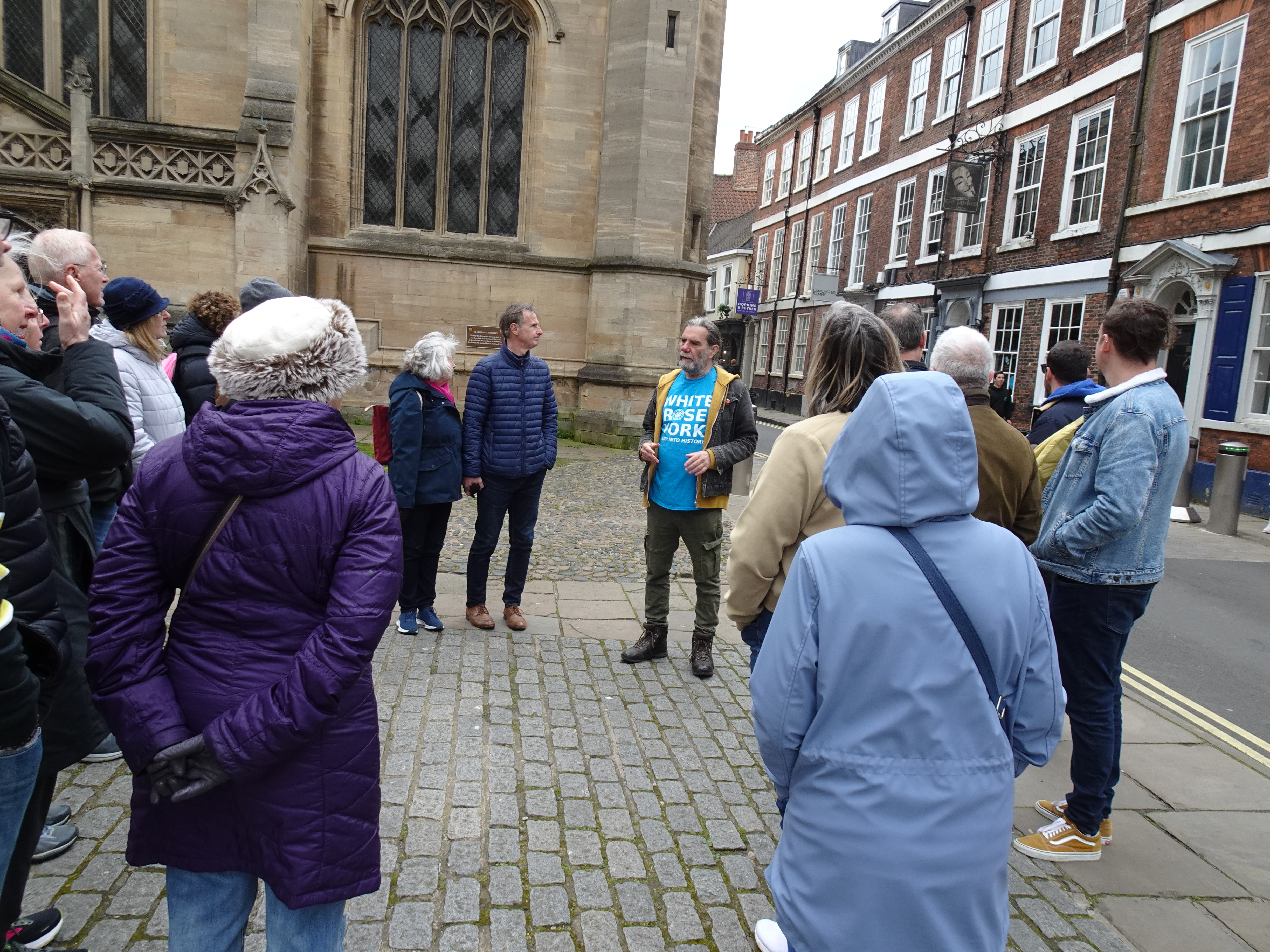
The excellent White Rose Tours. 
White Rose York Tours « Home of York's finest free tour – Daily at 11am and 3pm

One of the first things we did during our one-day visit to York was to go on the highly acclaimed White Rose Tour (See above - I would recommend this tour). This provided an excellent overview of the History of the City of York, from Roman times through King Charles I convening his court outside the city gates to the recent confectionary industry in the city.  Given some of the changes, traumas and brutality the city has witnessed it help reinforce my not entirely rational feeling that either history had ended or that I was simply a detached onlooker for whom history didn't happen. 

Coming from Norwich, a city which according to Wiki claims to be the most complete medieval city in the United Kingdom, it was inevitable that I'd compare York with Norwich. They have similar population size, but Norwich is far more sprawling & has undergone haphazard modernization. As a result, York gives the impression of being more densely packed with history than Norwich, especially in the famous "Shambles" area.....


The Shambles, York. 

The original fortified Roman town of York is buried under the center of the modern-day city and therefore has a largely archeological presence. This contrasts with Norwich where the nearest Old Roman town is five miles south of Norwich at Caister St Edmund. At Caister there is a very visible square embankment along with some remaining Roman walls. Norwich was founded by Saxons at least one hundred years after the Romans left York. Unlike York I'm not aware that the ghosts of Roman soldiers have been sighted in Norwich, although it is claimed that a Roman crossroads existed in the Charing Cross area of the city.

York has a huge claim to fame in the annals of Western history; namely, that Constantine the Great was declared emperor by his troops in York after his father (the emperor at the time), died in 306 whilst staying in York. I don't think Norwich has so significant a claim to being on the critical path of Western and European history. In the civil wars which often accompanied the succession of Roman emperors Constantine was eventually victorious and became the official emperor in 324. In 325 he presided over the council that gave Christian history the Nicaean Creed, a creed which has so influenced Christian thinking since. Constantine can therefore claim to have set the conceptual and geographical mold for European Christianity which has affected belief and politics right up until the present day with its division (and tensions!) between Eastern orthodox Christianity and the Western expressions of an abstract Christian ethos.  As one walks around the quaint streets of York it is difficult to believe that critical path events took place here profoundly affecting the evolution of both European and world events.

A very imperial looking statue of Constantine with the
 Minister walls in the background


Constantine and Europe's religious foundations.


But before all that happened York was to pass out of Roman influence and the remaining Romano-British faced Anglo-Saxon migratory infusions followed by Viking conquest. The Vikings took over the city of York in 866 (As they did also Norwich). The Jorvik experience with its animatronic Viking tableaus (which include the unpleasant smells of the time!) provides the detached end-of-history observer with a life-like almost time machine experience of the Viking past. With its smells & noises it is a very visceral experience. In fact, it reminded me of one of those fairground rides that takes you into the depths of another world. It was dark like the ghost train except that this wasn't fantasy: This was Danelaw Britain circa 800 AD and I was looking at ghosts from our past.  

One can't help but measure up Danelaw living conditions with our own "end of history" standards. To the comfortable 21st century UK citizen to whom even Roman life seems very uncivilized, the Viking context is intolerably primitive and squalid.  However, it is no doubt true that history has been unkind to the Vikings: Their history was largely written by those highly literate and learned Anglo-Saxon monks who were on the receiving end of ambitious Viking savagery.  And yet it was clear to me from some of the exhibits at the Jorvik Centre that Viking metalwork was much more advanced than the rumored history I was acquainted with would give credit for. In particular I was very impressed with a Viking padlock, and I spent some time studying it. 

Real Viking ghosts!
Travel back to Viking times at the Jorvik Center in York


But even the Vikings eventually converted to Christianity's compelling revelation of a God of sacrificial giving and love. In fact, one tableau was of a Viking Monk giving the Christian last rights to an old woman as she died not in battle but in her bed. Given Viking maritime culture the patron saint who naturally appealed to them was St Clement, the martyr who was executed by being tied to an anchor and thrown into the sea. So even the jingoistic Vikings who reveled in force of arms and reckless brutal courage started paying at least lip service to the Christain revelation of a God of voluntary vulnerability & sacrificial love (Philippians 2:1-11). How ironic. It was these people along with other European cultures who were to eventually bring riches and advancements that they couldn't possibly imagine at that time. So, we can thank these primitives for their adventurousness, ambition and above all their conversion to Constatine's faith. Amazing. Unbelievable. Beyond remarkable.

***

The highlight of our visit was of course York Minister. It is the largest gothic period cathedral, bar one:

The present building was begun in about 1230 and completed in 1472. York Minster is the largest cathedral completed during the Gothic period of architecture, Cologne Cathedral only being completed in 1880, after being left uncompleted for 350 years. (Wikipedia)

Because of its size in cramped York surroundings, it is
 difficult to find a space where one can stand back far enough
from the Minister to get the whole building in one frame.

In this cavernous interior the medieval mind would have
 boggled at the paradox of God's overwhelming and intimidating
glory when set against the miracle of His voluntary
self-abasement as recorded in Phil 2:1-11

As I looked heavenward this view gave me vertigo!
Perhaps the architect would have said "Good,
it is meant to!"

So much about York Minister is record
breaking, like for example this huge 
east end window, bigger than a tennis court.


York Minister may well have been built on the top of the very spot where Constantine the Great was declared emperor by his army; that would be a fitting tribute and crowning glory to Constantine's conversion to Christianity. This conversion turned out to have momentous historical consequences and of such import that it perhaps even left a disturbance in the psychic field around York, thus explaining the well-known ghost sighting of Roman soldiers in the basement of the Treasurer's House! (See also here). After all, if I'm right about the nature of conscious cognition, reality isn't "out there", but "in here"! Are apparitions evidence that reality sometimes malfunctions and expresses itself as a kind of reified dream state?

One has to admit that not that many conversions to Christianity are followed by all together exemplary lifestyles: Highly self-motivated Christain kings seeking personal glory continued to fight, squabble and build empires by force of arms, often quite sure they were meeting out the judgement of God. (But then I continue to sin myself, mostly sins of omission I think).  Perhaps the effect of Christianity is a slow burner effect: We are still a long way from peace and social harmony, a harmony that is metaphorically well represented by York Minister's glorious round west end window:


What medieval mind invented this wonder? But like
other gothic structures it probably evolved bit by bit. 

Is the medieval Cathedral building period the zenith of Christianity, a Christian culture whose tide has since turned as Matthew Arnold's poem Dover Beach would have it?  Ironically the individualism of Berean self-criticism (See Acts 17:10ff) which the protestant revolution unleashed is, I propose, implicated as the main cause of the turning of the tide of the Sea of Faith. The individualistic self-analysis and self-criticism encouraged in the Bible easily turns to criticism of others and when it is supplemented by the doctrine of the power of the laity it follows that every voice is a good as everyone else's voice. So, given humanity's epistemological challenges the very natural outcome of protestant Bereanism is that self-aware critical analysis should ultimately be brought to bear on Christianity itself. The power put into the hands of the laity by the protestant reformation has in turn lead to a slow burner revolution which has ultimately entailed that a take-it-or-leave-it opportunity be applied to Christianity itself and in consequence many have left it. This outcome, ironically, seems to be the ultimate outworking of Protestantism. But at least it means that in the democratic West no one is badgering one about the state of one's faith, whether it be one of belief or unbelief. So perhaps this very freedom of faith is the ironic pinnacle of Christianity? But today this private working out of one's personal salvation is in danger from traditionalist authoritarians and autocrats residing in both the east and the west.

Monday, 27 May 2024

Visit to York: The End of History Experience. Part I

I wish to God he was right but with Godfathers like Xi, Putin,
Kim Jong-un & Trump at large not to mention those religious  
hegemonists Francis has had to think again! 

Francis Fukuyama popularized the phrase "The End of History" with the publication of his book "The End of History and the last man" in 1992.  With the end of the cold war and Western democratic values in the ascendency and their capitalist economies generating technology & wealth undreamt of since the beginning of history it might have seemed that we were now all going to live happily ever after in the democratic lap of luxury. Moreover, many smaller countries still under authoritarian yokes wanted to join the rich democratic club, naturally enough. Well, we now know what happened:  Russia and China became powerful dictatorships, religious fundamentalists of differing brands sought the universal hegemony of their oppressive ideas and in the West a recrudescent far-right promoted lies and conspiracy theories in order to reinstate the demagoguery of Godfather style Government and the conceptual world-view of the unwoke. Does this mean we are on the way back to the Sauline worlds of monarchs (1 Samuel 8: 7-18) vying for as much power as possible and magnifying their personal glory via the violent extension of their empires of power? Such are the slaves & dupes of games theory as they make and break alliances in the monarchical ebb and flow of political influence. Traditional history with its unstable games theory feedback systems is very much back with us. 

And yet in a recent visit to the historic city of York (with the wife) the phrase "The End of History" kept coming back to me. I had had a sheltered and comfortable life untroubled by the privations of having to scratch an existence and free from the war & strife stirred up by Godfather rule. I had the education, health, time and comfort to take stock of the world around me. This privileged position allowed me to evaluate in a detached sort of way, the human condition and all that happens under-the-sun.  In a few more years, like my parents, I'm likely die in my bed. and history for me personally ends in a whimper. How anti-climatic!

***


On the way up to York we visited the Palladian Cusworth Hall which overlooks Doncaster from its far-seeing hillside (see picture above).  The remnant of its aristocratic owners sold the hall to Doncaster city council about 70 years ago. The estate is now run as museum by the council with free entry. (But we made a donation). The council keep the hall in good condition, and it has become a specimen in a protective "resin block" ready for curious "end of history" visitors like ourselves with the time on our hands to be thoroughly nosey about the affairs of those who came before us.  

With the wind whistling through the crevices of the house, few other visitors about and the architectural vestiges of a past glory still evident, the house had an abandoned feel about it. It was no surprise when a steward told us that the Hall was haunted and he himself had heard the stories. I've never seen or felt anything that remotely classifies as a haunting. In fact, the wife and I have visited places with the scariest of ghostly reputations and never experienced anything spooky (most notably Bodmin Jail). I was three years working at the haunted Blickling hall and saw and felt absolutely nothing. 


The above picture is of Cusworth Hall's grand staircase, just inside the entrance. After the long driveway with the Hall sitting conspicuously at its end the staircase is the next item on the chorography of status, a chorography designed to impress the visitor. In halls larger than Cusworth I've seen grander staircases but given a hall's size architects would endeavor to make the staircase a statement of the owner's wealth by making it as impressive as possible. Compare the above picture with the main staircase of No 1 the Crescent, Bath:


Being a terraced house, the staircase at No 1 is not as grand as Cusworth's, but nevertheless it does what it can to impress the visitor.  It's worth comparing these staircases with the entrance hall of our own late Victorian terrace house, constructed for the bottom of the end of an aspiring lower middle class where similar ideas about aggrandizing entrances were employed:


With its small footprint in a crowded city street the hallway of our house is inconveniently and painfully narrow, but the Victorian architects tried to mitigate this limitation by increasing the height of the house and its main rooms thus enhancing the illusion of space; it is affected grandeur on a small scale. But to those whose houses had no hall it sent out subliminal signals of being on the next rung of the status ladder and an illusion of keeping up with the De Montegues with their aristocratic Norman ancestry.  

Back at Cusworth Hall we found the main reception room to be decorated with some elegant Georgian plaster work. This would be the room where guests were entertained with music and formal dancing. 


In one of the wings, we found the chapel: In my opinion they should have decorated the chapel with similar elegant Georgian plaster work: Instead, we get a poor imitation of Italian mannerist/baroque art, in an attempt to echo Micheal Angelo's Sistine chapel. I'm no art critic but somehow the figures in this depiction looked as though they were made of dough rather than flesh. They should have stuck with stucco, but then the artist was probably good enough to convey, at first look, a sense of sophistication, & opulence and perhaps even help the owners affirm their faith in God.


To finish let's have look at Osterley House which we visited in 2010. It is much bigger and grander than Cusworth Hall. With its ogee turrets it is a peculiar blend of Elizabethan and later Georgian modernization. But somehow the pedimented Collonade goes well with the turrets although I doubt classicists would have thought so. And just look at that grand reception room below making Cusworth's reception look rather pokey. 

I include this house because of the part it played in Sir Keneth Clark's Civilization series at the beginning of the episode "The Fallacies of Hope".  See the end of this post where I wrote the following: 

 ***


At the start of the 12th episode of his Civilisation series we find Sir Kenneth Clark in the clean rational and regular neoclassical interior of Osterley House in England. As he looks upon this epitome of rational control he says:


A finite reasonable world, symmetrical, consistent and ….enclosed. Well, symmetry is a human concept because with all our oddities we are more or less symmetrical and the balance of a mantelpiece by Adam or a phrase by Mozart reflects our satisfaction with two eyes, two arms, two legs and so forth. And “consistency”… again and again in this series I’ve used that word as a term of praise. But “enclosed”, that’s the trouble. An enclosed world becomes a prison of the spirit, one longs to get out, one longs to move. One realises that symmetry and consistency, whatever their merits are the enemies of movement……and what is that I hear, that note of urgency, of indignation, of spiritual hunger, yes it’s Beethoven, it’s the sound of European man reaching for something beyond his grasp. We must leave this trim finite room and go to confront the infinite. We’ve a long rough voyage ahead of us and I can’t say how it will end because it isn’t over yet. We are still the off spring of the Romantic Movement and still victims of the fallacies of hope.

The romantics of the late 18th and 19th centuries rebelled against the deconsecration of the cosmos through the symmetries and regularities of enlightenment thinking and yearned for the infinite. They attempted to return to a much more intuitive apprehension of the natural world. As Clark says the journey isn’t over yet and even today our romantic intuitions and aspirations continue to do battle with our reason. I would suggest that two words are missing from Clark’s last sentence….victims of the fallacies of hope…in man!  !  ….. I want to look at the question of why science has left us high and dry…..

***

According to Clarke, then, we are still very much in the middle of history and Francis Fukuyama has had to go back to the drawing board! In the meantime, in Part II, I'll continue to play out this end of history fantasy as we move on to York and back to times a thousand years or more before the snobbish, self-satisfied and Whiggish post-Newtonian Georgian upper-class who to us feel very familiar and so close to our own times.

Thursday, 23 November 2023

Mersea Island

All pictures taken during my visit to Mersea island.


During a recent holiday on Mersea Island with the rest of the family the wife and I attended a Sunday service at the church of St Edmunds in West Mersea - see the picture above. The church is in the South of the Island a few yards from the coast. The island can only be accessed by a causeway subject to periodic tidal flooding. When one alights from the causeway at low tide St Edmunds is on the opposite side of an island which at the widest is about 7 km across.  Although Mersea island is not far from London these circumstances give St Edmunds that cut-off back-of-the-beyond atmosphere, an atmosphere which also pervades Happisburgh and Terice House in Cornwall.


St. Edmund's, Nave and Chancel


The fabric of the church displays evidence of a long history of change, structural improvisations and innovations. The north aisle is separated from the main nave by a colonnade of relatively spindly perpendicular columns; this aisle may well be a lean-too extension constructed post-black-death to accommodate an expanding population; add-on aisles, along with perpendicular replacement windows. are a feature of many rural churches.

St Edmund's disused pulpit


During the service the minister stood in front of the congregation with a lectern as might a minister in a non-conformist church. But in times past the priest would have occupied the old wooden pulpit displaced to one side, which like a sentry box guarded the chancel end of the church, the holy domain of the priesthood and the dispensation point of the holy sacraments. To non-conformists like myself the division between laity and clergy is alien. But that doesn't mean that it is without merit, especially given the feudal context of a largely illiterate and hard worked serf population. For them theology was built into the spatial configuration of the church, in its artwork and of course taught by the literate clergy. The latter was a dangerous undemocratic arrangement, but a lot more social, political and technical development was needed before this could be changed: One wonders if today's evangelical celebrity culture of so-called "anointed" patriarchs is any less dangerous.   

The downsides of the feudal priesthood are offset somewhat by the eloquent symbolism in the fabric & ritual found in these mediaeval churches. The communicant's attention is drawn to the centrality of Christ's sacrificial work, expressed by the positioning of the chancel where the tokens of Christ's sacrificial suffering are celebrated. The rituals in the chancel are assumed to be so holy that only an ordained priest can serve in that area. This practice does cut across the priesthood of all believers (1 Peter 2:9) but it is a far cry from the days of the pagan temples where an image of the divine represented by an idol stood in what is now the chancel. These idols would very likely depict figures of strength, power and glory; the very opposite of what we find in medieval churches which celebrate a self-humbling servant God and the vulnerability & martyrdom of his disciples like St Edmund. 

St Edmund's east-end-stained glass showing
Christ-child, Mary and cross-cultural worshippers


Behind the altar Cross at St Edmunds is the usual large colourful stained-glass window, in this case depicting Mary and her holy baby, the creator of all things (Col 1:15ff) contracted to the humble frame of an infant. This is the omniscient, omnipotent and omnipresence creator who in his desire to serve and save surpassed all conceivable limits of self-denial. Sacrificial self-denial is the central theme of Christianity, and the material fabric and rituals of these old churches attempt to convey this message; but one needs to know how to read it.

***

We also visited the church of St Peter and St Paul in West Mersea. This was another lesson in the  meekness of God.  A neat and attractive yew tree lined path leads to the north-door.....

Path leading to St Peter's and St Paul's

The entrance opens up on a clean and well-kept interior....

St Peter's and St Paul's nave and chancel.

Hanging over the entrance to the chancel is a large crucifix...

St Peter's and St Paul's crucifix

This image doesn't wallow in the awful bloody physical realities of crucifixion - if did it would be a distraction. But the pathos of the slumped body of Christ sufficiently conveys what it needs to convey; namely, the passion and compassion of a God who suffers for His creation. These verses in the book of Colossians tells us why....

 For God was pleased to have all his fullness dwell in him, and through him to reconcile to himself all things, whether things on earth or things in heaven, by making peace through his blood, shed on the cross. (Colossians 1:19-20)

The entrance to the medieval equivalent of the holy of holies, the chancel, is guarded by this image of a suffering God: One should not enter the holy of holies from which the grace of communion is served without cognizance of the Crucifix and what it means. Once one has entered this sacred area one then looks up at the rich stained-glass window of the east-end and sees the glorified risen Christ, clothed in the sumptuous robes of The Only King worthy of the name. (See picture below and also Phil 2:1-11). All this proves that imagery is not necessarily idolatry: An image is idolatrous when it is the depository of a corrupt concept of God; take away the image and the distorted concept of God it represents remains and so does the idolatry. We all have a distorted image of God to a greater or lesser extent, and that's why pointing to Jesus short cuts the risks of the idolatry we are prone to promote; see Hebrews 1:1ff. There is nothing wrong in imagery per se, provided it points us to the express image of Jesus (John 1:18, 5:37, 14:9).

At St Edmunds the east-end-stained-glass depicted Jesus as a
helpless babe-in-arms, but at the east end of St Peter's and
 St Paul's we see a post-cross glorified risen Jesus. 

***

In these old churches we see part of the long process of the civilization of a barbaric humanity: Gone were the overbearing easily offended deities of paganism who jealously guarded their power, glory, status and reputation much as a human dictator (e.g. Donald Trump and Vladimir Putin) might. Jesus turned these pagan values on their heads and showed us what Deity, Real Deity was about. The war-like pagans of the northwest miraculously started to celebrate vulnerability, naming their churches after Saints like St Edmund who were martyred for their divine King. Even the Vikings who killed St Edmund eventually Christianized and frequently named their churches after the martyred patron Saint of Sailors, St Clement.  It's a remarkable history, but let's be clear; there is still a very long way to go to complete the civilization of humanity, and both left-wing and right-wing dictatorships are forever waiting in the wings for an opportunity and remain a risk to civilization, and Christianity.   

***

Attending the traditional service in the medieval churches of the UK is like going back in time. For me this feeling of time travel was particularly strong during the service at St Edmunds as we read out the age-old liturgy from printed sheets. Medieval congregations would of course not have had printed sheets to read and wouldn't have been able to read them even if they had. In those distant times the laity would have had to recite the liturgy Sunday by Sunday from memory. This, along with the symbolism and imagery in the church, was the way to teach an illiterate peasant congregation about salvation. 

Medieval Christianity was highly authoritarian and top down, but ours is a world of dynamic continuity; the logic of society was such that it wasn't ready for a more politically participatory community. A culture of finite beings can't absorb everything at once but instead goes through a series of learning stages. For human beings the unfolding of revelation is the unfolding of time. Time exists because revelation is necessarily a sequenced affair. The division between laity and clergy is easily abused and was abused in medieval times. But it seems that a pre-renascence, pre-print, illiterate feudal society had little choice but to pass through this primitive stage of social & political development, not to mention the need for the technical developments which were to revolutionize society. 

Sunday, 30 July 2023

Wollaton Hall, Nottingham


Wollaton Hall is the atmospheric context of a very interesting 
natural history display. I can recommend a visit. 


After my last post on the homely Elizabethan Trerice House in Cornwall I thought I'd post on the very contrasting stately home, Wollaton Hall, which is also Elizabethan, but by intention far from homely. It classifies as a "prodigy house", that is house which self-consciously wallows in its very contrived grandeur. Blickling Hall, where I worked for three very pleasant years, classified as a prodigy house. (See also Hatfield House, by the same architect). Stately homes in this category are intended to be awe inspiring rather than homely. If the sense of awe they generate comes at the price of mixing in a little fear and intimidation then so be it: The owners of these houses wanted their high status to be all too apparent regardless of any accompanying sense of discomfort these houses engender; if anything, a little fear enhances the feeling of awe & respect; ask any dictator. 

Wollaton Hall can be reached by a climbing the rise on which it is situated. As no doubt intended its profile dominates the surrounding landscape (see above). As one closes in on it the rich ornamentation of its facade becomes very striking: If that ornamentation looks ostentatious to the viewer, then it has probably achieved its purpose of manipulating the feelings of the visitor: The Hall shouts wealth and status at the expense of any negative feelings one might have about the mood it conveys.  It is not built to primarily make friends with the viewer, but at all costs to impress even if that evokes a sense of being over-awed. Rich and powerful people tread a very a precarious path that runs temptingly close to assuming demigod status. 


Just inside the entrance of the palace is a very lofty hall of equal grandeur: Its elaborate ceiling bosses are surrounded by grotesques which peer down at the visitor giving the first inkling that this could be a spooky place; in fact, the Hall makes claim to being the haunt of several ghosts. 


The Hall is now a natural history museum, and it is atmospheric enough to serve well as the setting for one of those "A night in the museum" thrillers, where fearful exhibits start to stir in the darkness!


It was very appropriate then that we came on the day that a special exhibition had been laid on: In fact, we had come to the Hall to see this monster......

T-Rex lunges at his next victim!

... the real bones of a gigantic T-Rex. More than 65 million years ago these now fossilized bones were running around terrorizing the population of lesser dinosaurs. For a T-Rex to grow to these dimensions it must have cost the lives of many other dinosaurs; how many dinosaur hides had those wicked looking teeth sunk themselves into?  Like the original owners of Wollaton Hall he was at the top of his game; he was not called "Rex" for nothing!

It was easy to imagine T-Rex roaming the corridors and large rooms of Wollaton Hall (although doorways would pose a problem!). In terms of size human constructions have far exceeded dinosaurian scales and yet in comparison even these scales pale on the cosmic stage. Moreover, the immense tracts of cosmic time make the 165-million-year reign of "the grotesque saurians, the huge brutes of Jurassic times"* look to be very ephemeral. The apparently pointless long reign of saurian survival hangs over any curious theist as an enigma.

Like Wollaton Hall the cosmos is an awesome, spooky, even a frightening place, intimidating in its size & detail and yet paradoxically beautiful at the same time. It is no wonder the general populace are having trouble making anthropic sense of it all  Ways of cutting the gordian knot quickly are sought for: Some throw their hands up in disbelief, resorting to explanations of sheer chance and believe the cosmos has no anthropic significance. Cranky Christian popularist sects, unable to come to terms with cosmic dimensions, have cosified it with those incredible shrinking doctrines of young earthism (and even flat earthism) and sought assurance, security and above all certainty by running after authoritarian, presumptuous, delusional and even corrupt leaders who tell them what they want to hear.

As for me I find I can't be too hard on either atheist or the average cranky cult Christian: Both are understandable intellectual short-cuts given the tricky questions that are part of the human predicament; these are reactions which in my view are completely undeserving of the traditional hell.  So, it's over to you God; it's your problem not mine.  

Footnote:

*The Time Machine, The Epilogue, by H G Wells.

Relevant Link: